What Is the Difference Between Bookkeeping and Accounting?
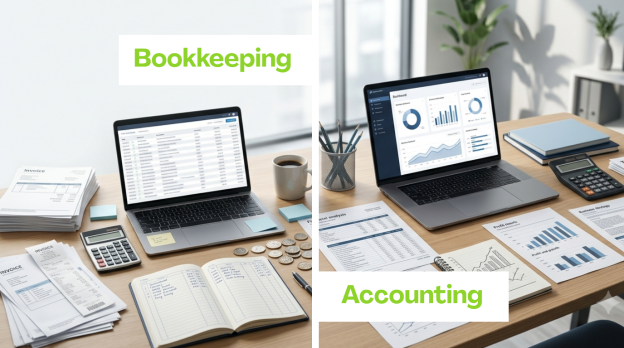
Bookkeeping is the administrative process of recording daily financial transactions and balancing bank feeds. Accounting is the strategic analysis and legal reporting of that data. Bookkeepers keep your business records clean and organized, while accountants use those records to structure your tax efficiency, handle payroll, and file mandatory corporate returns with HMRC and Companies House.
The Post-2026 Compliance Reality for UK Companies
For UK startups, the operational divide between incorporating a business and running its daily ledgers is where many early-stage founders stumble. Proper financial management is no longer just about basic operational housekeeping, it is a strict legal compliance requirement.
Historically, many founders attempted to bootstrap their financial administration, relying on basic spreadsheets and free government filing portals to save money. However, the regulatory landscape has drastically shifted. HMRC and Companies House have modernized their infrastructure, ending legacy manual entry methods entirely. For modern founders, avoiding severe filing penalties requires understanding the distinct roles of bookkeeping and accounting from day one.
What Is Bookkeeping and Why Is It Crucial for Startups?
Bookkeeping is the administrative foundation of your entire financial system. A bookkeeper’s primary objective is to ensure that every single penny entering or leaving the business is accurately documented, properly categorized, and backed by a clear financial history.
Daily bookkeeping tasks include:
- Recording daily sales revenue and operational expenses.
- Generating, sending, and managing client invoices.
- Organizing supplier receipts and purchase orders.
- Conducting regular bank reconciliations across all corporate accounts.
- Managing multi-currency tracking and cross-border invoicing for international transactions.
Poor bookkeeping corrupts your primary financial data. When year-end approaches, an accountant cannot optimize a tax return built on broken ledgers and missing receipts. Without highly accurate, disciplined bookkeeping, higher-level financial analysis or tax preparation becomes impossible to execute correctly.
What Is Accounting and How Does It Support UK Compliance?
Accounting turns raw transactional data into business intelligence and legal compliance. It takes the records provided by the bookkeeper and transforms them into actionable insights and legally mandated statutory submissions.
Core accounting responsibilities include:
- Preparing and filing mandatory Annual Accounts with Companies House.
- Calculating corporate profit and filing highly accurate Corporation Tax returns (CT600) with HMRC.
- Preparing and submitting quarterly VAT returns under Making Tax Digital (MTD) rules.
- Providing strategic advice regarding tax efficiency, dividend structuring, and capital allowances.
Following the definitive closure of HMRC’s free joint online filing portal (CATO) on 31 March 2026, manual web filing is no longer an option. Every UK company must now use approved commercial software to format and submit their accounts and tax returns. An experienced accountant ensures your business smoothly navigates this mandatory software configuration without missing statutory deadlines.

How Do Bookkeeping and Accounting Work Together?
Bookkeeping and accounting operate in a direct, sequential relationship. An accountant is entirely reliant on the accuracy of the bookkeeper. If a startup’s bookkeeping is flawed, disorganized, or plagued by missing receipts, the accountant will inevitably generate incorrect financial reports.
The Impact of ECCTA Regulations on Startup Data
Under recent updates to the Economic Crime and Corporate Transparency Act (ECCTA), Companies House cross-references corporate filings with greater tracking intensity. Bookkeeping data entry must match verified corporate bank records perfectly. Any inconsistencies in director transactions, unregistered address changes, or undocumented capital transfers will quickly trigger compliance flags, risking direct personal penalties for company officers.
Bookkeeping vs. Accounting: At a Glance
| Feature |
Bookkeeping |
Accounting |
| Primary Focus |
Recording daily administrative transactions. |
Analyzing and interpreting financial data. |
| Timeline |
Present-focused (daily and weekly tracking). |
Future & Past-focused (year-end and forecasting). |
| Main Deliverable |
Clean bank reconciliations and general ledgers. |
Tax returns, annual accounts, and tax optimization. |
| Legal Mandate |
Keeping accurate records for company files. |
Submitting certified, software-compliant filings to HMRC. |
| The Primary Goal |
Keeping the corporate data organized. |
Making the data compliant and tax-efficient |
The Hidden Risks of Poor Financial Record-Keeping
Failing to split and manage these two functions properly introduces severe operational and legal risks. If your internal records do not align with external bank statements due to a failure to reconcile accounts regularly, you risk making critical business decisions based on inaccurate data.
- The Director’s Loan Account Trap: New founders frequently mix personal funds with business spending. Without a bookkeeper to log these transactions properly, these balances end up in a Director’s Loan Account, which can trigger unexpected tax penalties from HMRC if left unreconciled.
- Automatic Filing Fines: If disorganized records cause you to miss your filing deadlines, Companies House issues immediate fines. For a private limited company, being up to one month late triggers an automatic £150 penalty, which escalates to a punishing £1,500 if the delay stretches beyond six months. These penalties automatically double if the accounts are filed late in two successive financial years.
Transition your registration documents straight into clean ledger tracking. Book a direct compliance onboarding session with our team to keep your business perfectly prepared for year-end.
👉 Explore Our Bookkeeping Services
When Should a UK Business Outsource Its Financial Management?
Attempting to manage both bookkeeping and accounting internally is a massive drain on a founder’s time. Startups often operate with small teams, and forcing a CEO to act as a part-time bookkeeper stunts business growth and introduces compliance risks.
Outsourcing these functions provides a structured, highly affordable approach. Hiring an experienced, full-time in-house Chartered Accountant in the UK typically demands a salary between £40,000 and £70,000 annually, excluding benefits and software costs. By choosing a strategic outsourcing partner, startups drastically reduce these costs while completely removing single-point-of-failure risks like staff turnover or sick leave.
How FormationsHunt Provides Affordable Support
FormationsHunt bridges the gap between expert fiduciary oversight and startup-friendly pricing. We provide flexible solutions that keep your records clean and your company fully compliant.
Startups can utilize expert Bookkeeping Services for just £20 per hour, ensuring daily financial accuracy without the commitment or overhead of a full-time hire.
FormationsHunt protects your business compliance from every angle with our All-Inclusive Accountancy Package, starting at a budget-friendly £65 per month. This covers the essential accounting needs of your business, including:
- Annual Accounts Preparation and Filing (fully software-compliant)
- Accurate Corporation Tax Calculation and Filing
- Complete PAYE Payroll Management for up to three employees
By outsourcing both functions to a single provider, founders ensure a seamless flow of data from daily bookkeeping directly into legally compliant accounting submissions.
Leverage Free Accounting Software for Better Growth
Modern corporate accounting relies on direct software synchronization. Because HMRC automatically rejects non-compliant formats, your accounting platform must sync flawlessly with active bank feeds. Submitting standard spreadsheets or PDFs will result in an automatic rejection. Our packages handle the entire software setup for you from day one.
Now that manual government joint portals have closed, team up with FormationsHunt to automate your accounts and secure 6 Months of Premium Xero Access Free.
👉 Click the Banner & Claim Your Free Xero Setup

Frequently Asked Questions (FAQs)
1. Which financial tasks do startups commonly delegate to external experts?
Startups frequently hand over their essential day-to-day and annual financial responsibilities to specialized agencies. This typically includes:
- Routine bookkeeping and daily expense tracking.
- Year-end financial statements and annual account preparation.
- Corporation Tax calculations and submissions.
- Monthly payroll management for growing teams.
- Quarterly VAT tracking and compliance.
By offloading these core functions, founders ensure airtight compliance without the financial burden of a full-time internal hire.
2. Is hiring an internal accountant more expensive than outsourcing?
Without a doubt. Employing a dedicated, full-time accountant in the UK generally demands a salary upwards of £40,000 per year—and that’s before factoring in recruitment costs, employee benefits, and expensive software licenses.
In contrast, an outsourced accounting service gives you access to an entire team of specialists and top-tier software for a predictable, fixed monthly fee, with basic packages starting as low as £65/month.
3. When is the right time to hand over your startup’s bookkeeping to external experts?
There are two ideal windows to make the switch:
- Right after incorporation: This allows you to establish robust financial frameworks and clean workflows from day one.
- Just before major growth milestones: Such as onboarding your very first employees or approaching the £90,000 VAT registration threshold.
4. Is it possible for international founders to safely outsource UK accounting?
Yes, entirely. A dependable UK-based financial partner can seamlessly oversee your company’s compliance from afar. They will handle the latest Companies House identity verification requirements on your behalf and manage your year-end tax submissions completely remotely—meaning you never need to set foot in the UK to keep your business running smoothly.
5. What are the financial penalties for overdue annual account submissions?
Failing to submit your accounts to Companies House on time triggers automatic, escalating financial penalties. The fine increases based on how late the submission is:
- Up to 1 month late: £150 fine
- 1 to 3 months late: £375 fine
- 3 to 6 months late: £750 fine
- Over 6 months late: £1,500 fine
6. What is a Director’s Loan Account, and how does it affect bookkeeping?
A Director’s Loan Account tracks any money borrowed from or lent to the company by its directors. Startups often run into compliance issues by treating corporate bank accounts as personal funds. Bookkeepers track these transactions separately to ensure your accounting team can properly reconcile your tax liabilities and avoid unexpected tax charges from HMRC.
7. How do international or non-UK resident founders manage cross-border invoicing?
International founders face unique bookkeeping challenges, including multi-currency reconciliation and handling cross-border VAT adjustments. Using localized bookkeeping structures ensures all foreign currency transactions convert accurately using recognized exchange rates, keeping your year-end annual accounts fully compliant with UK statutory standards.
Secure Your Financial Foundation Today
Understanding the distinct difference between bookkeeping and accounting is the first step toward building a highly resilient, legally compliant UK business. Bookkeeping provides the organized, accurate data, while accounting uses that data to ensure statutory compliance, calculate taxes, and drive strategic growth.
By choosing to outsource both your bookkeeping and accounting functions to trusted experts, you save valuable time, eliminate expensive errors, and gain profound clarity over your finances.
Let the experts handle the numbers while you focus on building your vision. Explore FormationsHunt’s All-Inclusive Accountancy Package today for just £65/month.

 Client Login